
The initial “wow” factor of generative AI often masks a looming logistical crisis for product teams: the fragmentation of brand identity. It is relatively simple to generate a single, high-fidelity hero image that captures the essence of a new product launch. The difficulty arises when that one image needs to become fifty—spanning Instagram Stories, LinkedIn banners, email headers, and localized landing pages.
In a traditional workflow, a creative director ensures that lighting, texture, and color palettes remain synchronized. In a high-volume AI workflow, “visual drift” becomes the default. A model might generate a stunning minimalist aesthetic for a desktop banner, only to pivot toward high-contrast saturation when asked to produce a vertical asset for social media. This lack of continuity forces teams back into endless prompting cycles, eroding the efficiency gains that AI was supposed to provide.
To scale asset production without sacrificing the brand’s soul, teams must move away from the “lottery” of iterative prompting and toward a structured pipeline. This involves selecting a high-consistency base model like Nano Banana Pro and utilizing surgical editing tools to lock in visual variables across a campaign.
The Fragmentation Trap in Rapid Asset Production
When teams are in the heat of a launch, the pressure to produce creative variants often leads to “one-off” wins. An operator finds a prompt that works for a specific background, but that prompt fails to translate when the product needs to be placed in a different environment. This is the fragmentation trap.
Visual drift is not just a stylistic annoyance; it is a performance killer. If an ad on Facebook looks fundamentally different from the landing page it directs to, the cognitive load on the consumer increases, and trust in the product decreases. Generic models often struggle with “memory.” They lack the inherent capability to understand that the specific shade of brushed aluminum on a product must remain consistent across different lighting conditions.
As a launch approaches, the workflow must shift from creative exploration—where variety is welcomed—to production-grade consistency. This requires a transition from generalist LLMs to specialized models that prioritize structural integrity over mere “creativity.”
Establishing the Baseline with Banana Pro AI
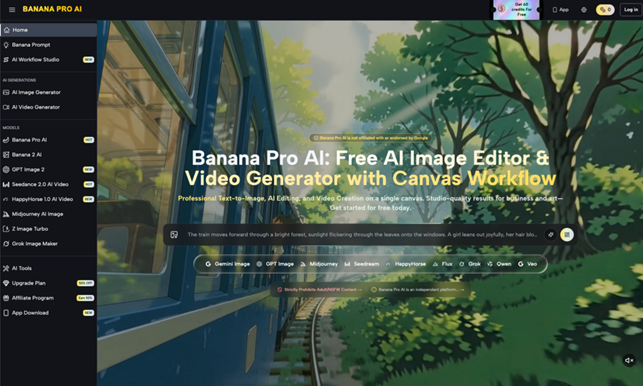
The foundation of a cohesive campaign lies in the model’s ability to hold a specific “weight” and realism across multiple seeds. In our evaluation of production-grade workflows, Nano Banana Pro has emerged as a reliable baseline for teams requiring high structural consistency. Unlike models that hallucinate wildly different geometry between generations, this architecture tends to respect the spatial logic of the original prompt.
When using Nano Banana Pro, the goal is to establish what we call the “Golden Seed.” This is the specific combination of model parameters and prompt structure that perfectly captures the brand’s aesthetic. Once this is established, it serves as the North Star for all subsequent assets.
However, even the most robust model cannot account for every environmental variable. There is a persistent uncertainty in how AI interprets complex “depth-of-field” requests alongside specific brand colors. It is safer to assume the base generation will get you 80% of the way there, leaving the final 20% to manual refinement. Expecting a 100% “ready-to-post” result from a single prompt is a recipe for missed deadlines and visual inconsistency.
Surgical Refinement via the AI Photo Editor
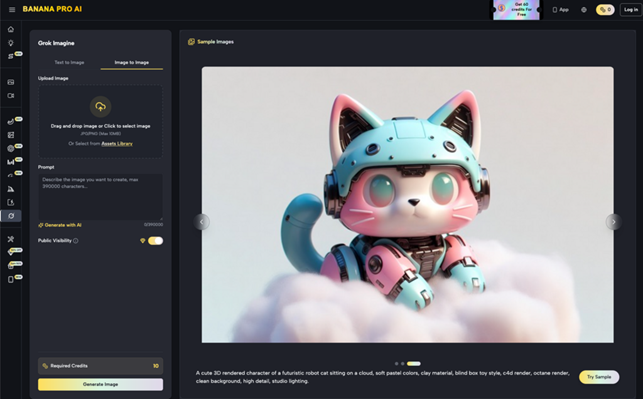
The most common mistake product teams make is “re-rolling” a prompt because a small detail is off. If the lighting on the product’s left side is too harsh, but the rest of the image is perfect, re-generating the entire image is a waste of computational resources and time. This is where the AI Photo Editor becomes the primary tool for professional-grade output.
Surgical refinement allows operators to fix artifacts or adjust lighting without changing the core composition. For example, if a generated background for a skincare product looks too “digital,” the AI Photo Editor can be used to soften textures or introduce subtle grain that matches existing brand photography.
This stage of the workflow is about gatekeeping quality. It allows the team to take the raw output from Nano Banana and align it with the technical requirements of a high-conversion landing page. It is important to note, however, that while editing tools have become remarkably intuitive, they still require a human eye to ensure that “corrected” lighting doesn’t look pasted on. AI can suggest the pixels, but it cannot yet fully understand the physics of a specific real-world scene without guidance.
From Hero Shots to Ad Variants: The AI Image Editor in Action
Once a hero asset is finalized, the challenge shifts to adaptation. A hero shot designed for a 16:9 web header rarely translates perfectly to a 9:16 mobile format. Standard cropping often cuts off vital focal points or ruins the balance of the composition.
Using an AI Image Editor designed for production allows teams to scale for performance. Instead of simple cropping, these tools use generative expansion or “outpainting” to fill in the canvas while maintaining the thematic resonance of the original shot. If your campaign uses a “cyberpunk minimalist” aesthetic, the editor ensures that the newly generated margins of a vertical ad carry that same lighting and color grading.
The role of Nano Banana Pro in this phase is to provide the “fill” logic. By referencing the original hero shot, the editor can generate secondary elements—such as architectural details or ambient lighting—that support the primary product visual rather than distracting from it. This ensures that the Instagram Story feels like a native part of the same universe as the desktop site.
Limits of the Current Pipeline: Where AI Still Struggles
Despite the advancements in models like Nano Banana Pro, there are clear boundaries that product teams must respect to avoid “uncanny valley” marketing.
First, text rendering remains a significant challenge. While some models are improving, relying on AI to generate final, crisp typography within an image is still a high-risk maneuver. For professional launch assets, it is almost always better to generate the visual background and then use traditional graphic design software to overlay the copy. This ensures brand-accurate fonts and prevents the “haloing” effect often seen in AI-generated text.
Second, there is an explicit uncertainty regarding 1:1 photorealistic replication of complex physical products. Unless a team has trained a custom LoRA (Low-Rank Adaptation) on their specific product from every angle, the AI will likely “guess” the details of the product’s underside or back panels. For products with highly specific mechanical details, AI should be used for environmental staging rather than as a replacement for high-end 3D rendering or photography of the product itself.
Finally, achieving perfect lighting continuity across assets with vastly different camera angles—such as a top-down “flat lay” versus a 45-degree “action shot”—remains difficult. The AI often resets the light source to a “default” position, which can make a series of images look disjointed when placed side-by-side in a carousel.
Building the Repeatable Launch Pipeline
To implement these tools effectively, teams should adopt a standardized protocol for every new campaign.
-
Define the Golden Seed: Spend the first phase of production finding the specific Nano Banana Pro prompt that aligns with the creative brief.
-
The 80/20 Rule: Allocate 20% of your time to generating raw options and 80% to refinement via the AI Photo Editor. The value is in the polish, not the volume of raw output.
-
Asset Adaptation: Use the AI Image Editor to expand and re-format the “Golden Seed” assets for various channels, ensuring that outpainted areas match the original’s lighting and texture.
-
The Human Overlay: Always finish with a manual check for “AI tells”—irregular shadows, floating objects, or blurred textures—before the assets are pushed to a live campaign.
Scaling asset production is no longer a question of how many images you can generate per minute. It is a question of how many consistent images you can maintain through the refinement process. By grounding the workflow in a stable model like Nano Banana Pro and utilizing surgical editing tools, product teams can finally bridge the gap between AI speed and brand-standard quality.
